Wednesday, April 9, 2025

Amy Tan seeks peace in the skies


For the writer and artist, observing birds charted a flight path to a more vibrant life

“When I started the Chronicles,” Amy Tan confesses in her latest book, “I could recognize only three birds in my [California] yard.” Six years later, that number had grown exponentially. There are 61 birds listed in the book’s appendix, and these are only, as Tan explains, “birds identified in my yard as of December 15, 2022.” Hence the title: The Backyard Bird Chronicles.

An accomplished writer of fiction (The Joy Luck Club and five other novels), memoirs, and children’s books, Tan came late to serious birding. That interest coincided with her dedication to learning how to draw. In Chronicles, readers follow Tan’s ornithological education while watching the evolution of a skillful artist. Tan provides dozens of her own story-driven cartoons (“Crime Scene! A Murder of a Crow”), beautifully rendered portraits — her golden-crowned sparrow is as regal as her Cooper’s hawk — and naturalist’s jottings. Those last include sketches of the subtly different “faces” adopted by great horned owls, expressions that range from happy and hangry to “mother love face” and “attack human face.”


Recently, Tan sat down with Rotary magazine to discuss the book. The conversation with veteran Chicago journalist Linda Yu extended into the emotional chaos of Tan’s childhood and the ways in which birding offered her insights on how to sustain sound mental health.

“‘Hope’ is the thing with feathers,” wrote the reclusive Massachusetts poet Emily Dickinson, “... the little Bird that kept so many warm.” The Belle of Amherst would likely get an enthusiastic tweet of agreement from Amy Tan, the Seer of Sausalito.

The Backyard Bird Chronicles taught me so much. Do you realize what your book has done for birds?

I did not realize it until people started telling me that they had started looking at birds and having these wonderful interactions. The reason why I’m happy about that is that people who love birds will also want to save them, and that means we will have more people concerned about conservation. That gives me such delight.

Seven words in the preface to your book really hit me. Talking about your childhood love of nature, you write, “It was my refuge from family chaos.” Can you talk about that?

When I was growing up, there was a lot of drama in our family. My mother was suicidal. Any little thing would set her off. You could see it on her face. Something was brewing that was unstoppable, and it would burst out: “Maybe I should just kill myself!” We kids would be terrorized. Even though she tried only a few times in front of us, it was enough that we were fearful that this next time would be it.

So sometimes I would go to a nearby creek and play with frogs and tadpoles and lizards and snakes and build forts and slide down the banks and jump into the puddles. This was my escape. It was so complete, being in the moment. The strange thing is I never really looked up to see the birds.


Illustration by Anna Higgie

What part did bird-watching play in healing yourself from the life you grew up with?

It wasn’t so much that I was trying to heal myself when I first started looking at birds. I have had a wonderful life, and I’m grateful for that. But I decided I needed to go to a place that was peaceful. I would be in this beauty in nature, and I would be focused on the smallest details and the patterns. Being in my yard was being in the moment, not thinking of the past, not thinking of the future full of anxieties. Seeing the miracles in front of me and being in a state of awe.

In your book you write that one of your mentors in birding instructed you to “be the bird.” Is that what you did?

John Muir Laws, who was my mentor and teacher for nature journaling, said that when you look at and are going to draw a bird, imagine that you are feeling the life force of the bird. And that’s important: the life force. That’s what gives the bird its ability to be there in front of you alive.

I’m a fiction writer, so I took that advice a step forward, which is to be the bird. Imagine I am the bird looking at me. It is this practice of imagination of being the other. And to me, that is the closest thing we do to compassion. When you’re compassionate, you are imagining the life of that person and the circumstances, the conditions, all the pressures and the sadnesses and the difficulties. You imagine being in their shoes and having their history.

One of the things people can do to feel better about themselves is to be compassionate toward other people. You realize the universals that we all suffer from — and you get to share the joys.

Did you use the drawing of birds as therapy?

I did not use it as an escape hatch. It was not with any other purpose but the love of drawing. It gave me such deep satisfaction that certainly, if I had depression, if I had anything going on, I could definitely get out of that headspace. It is a different thing to be in your own head for that long of a period of time. Not lonely, but in solitude with your mind and with your feelings. It’s a good thing to do something that is creative, doing something actively that is meaningful, that makes something that is beautiful or that’s fun. I think that is something that we don’t do often enough for ourselves.


In The Backyard Bird Chronicles, Amy Tan’s illustrations range from portraits to cartoons to these naturalist’s jottings.

Illustrations used with permission of Amy Tan. All rights reserved.

It might be important to gift ourselves with the understanding that it’s OK to do things we enjoy.

Absolutely. Understanding the many different aspects of life can really alleviate a lot of what makes us depressed, that feeling that there’s no way we can get a foothold on anything in life because something is dragging us down. Take one hour a day — or even just 10 minutes — and say, This is my time for myself. This is my hour to look at birds or read poetry or sew or whatever it is that changes your perspective. And then you realize, yeah, you do have control.

I should say that I don’t have depression now or some mental illness that is impeding my life. But I did have a period where I had all these medical maladies. I felt dull and unmotivated. Not really sad, but just kind of like blah. I thought maybe it’s psychosomatic, but I went to see a psychiatrist, and she thought it was medical. And she was absolutely right. I finally got a medical workup and it turned out it was Lyme disease. When I was treated for Lyme disease, all of this went away that had been weighing me down. But having had that experience, I empathize with people who have those disorders. I know what it feels like now to have unrelenting anxiety.

So is the advice then, if there’s a problem, to keep on searching?

We seek help in many different ways. But at some point it has to be within ourselves. I think that it helps if we can go into that place in ourselves and see if it’s possible to say to yourself first of all, It’s not my fault. But I know that I have to make an effort to help get out of this prison and never give up.

I’ve been with a lot of people also who are in the last days or even hours in their life. And I found that, with a lot of people who are dying, they go into that place and it’s actually kind of a wondrous place.

That happened at the end of your mother’s life, didn’t it?

Yes. She was in her second year of Alzheimer’s. She hadn’t been able to use a phone or a TV remote or to write for quite a while. She had lost her ability to speak for the most part. She called me up one day and I was shocked to hear her. She was absolutely clear, the way she sounded before she was sick. And she said, “Amy, Amy, I’m having a hard time. I’m really confused and I’m scared. I’m losing my mind and I don’t know what this place is. I just want to tell you before it’s too late that I’m sorry that I did things to hurt you when you were little.”

And I said, “No, no, no, you didn’t, you didn’t do anything. You don’t have to apologize.”

She says, “No, I know it’s true. And I just want you to forget like I’ve forgotten.” And that was the most healing thing that I could have gotten because suddenly it took away all the pain of the things that had happened in childhood.


In The Backyard Bird Chronicles, Amy Tan’s illustrations range from portraits to cartoons to these naturalist’s jottings.

Illustrations used with permission of Amy Tan. All rights reserved.

That’s so beautiful. Thank you for telling us that. Now, in your book you write about the sounds that birds make. You talk about the clicks that hummingbirds make and the cry that California quails make. I read what you wrote, but I want to hear it. Could I?

Oh God, I cannot imitate birds. For one thing, they have a syrinx and we have a larynx. They can produce sounds that we can’t possibly produce. However, I’ve discovered that you can imitate the intonation patterns of birdcalls and birdsongs, and some of the birds will actually recognize it. So my call to the hummingbird is just the intonation pattern. If I do that enough times, the hummingbird will answer back and then come to me.

What’s your favorite bird sound?

It’s the great horned owl. We had owls living in our backyard oak trees for about eight months. It was a mother and a son. The mother left in October, which was expected — she’d finished training him — and the son left in April. But the son came back with a girlfriend in October or November. They courted and did things, but we knew they would leave. We didn’t have any nests they could take over. But the other day, the girlfriend — we call her Moon Lady — came back, and she was there all day long. We were so delighted.

I love watching your smile when you talk about birds. It’s beautiful.

I saw a new bird a few days ago that’s basically never seen in a backyard. It hides in scrub bush and poison oak up in the headlands. It’s a wrentit, and I saw two of them, wandering, exploring feeders, just standing, bathing. It is so unusual.

And guess what? It makes me really happy. Any little problem I have, all I have to do is go out and look for those birds.

This story originally appeared in the April 2025 issue of Rotary magazine.


Visit :-

https://www.rotary.org/en/amy-tan-seeks-peace-in-the-skies


An immigrant finds belonging in Rotary

Far from home and seriously injured, a young man finds comfort and renewed purpose among his Rotary family

By 


“¿Dónde estoy?” I thought, returning to the world, all white light, blurs of color, and muffled sound. “Where am I?” My lips were so dry. “¡Agua! ¡Agua!,” I cried, asking for water. I struggled to get up, but my mother told me to lie still. I was in the hospital. Those blurs of color turned out to be balloons. There had been an accident, my Jeep versus a tree. The tree won. I’d been in a coma for two weeks.

I tried to think back. I remember driving my car after a long shift at the restaurant where I worked. Then nothing: no crash, no tree, no ambulance. No three major surgeries to drill a hole in my skull to reduce pressure on my brain and to repair my broken left hip and right clavicle. The doctors said that I was lucky to be in a coma for only two weeks. It could have been months. I might never have woken up.


Illustration by Hokyoung Kim

My life started coming back in patches. My name is Andrés Briceño. I was born in Venezuela, though today I live in Texas. I came to this country in November 2021 when I was 23 years old. I moved to The Woodlands, north of Houston, because an aunt and some of my cousins live here. But I also belonged to a larger, international family — Rotary — which I first joined when I was living in Venezuela as a member of both the Rotary Club of Las Delicias and the Rotaract Club of Las Delicias Leone Rossi.

When something is wrong, I want to change it. My dream was to see my country free. But freeing a country is not easy. When you defend freedom in a dictatorship, you become a target. Ultimately I had to leave.

A new club

After I arrived in Texas, I reached out to the Rotary Club of The Woodlands. It changed my experience as an immigrant. One month after my arrival in the United States, I attended the club’s Christmas party. I was far from Venezuela, yet the club’s members made me feel like I was home, that I belonged in their community. That was so valuable: being accepted, feeling like I belonged.

My accident was on 25 June 2023. The day before was a Saturday. It had been only three days since the Rotaract Club of The Woodlands, which I was instrumental in establishing, was officially chartered. I woke up very early. It was a hot summer day. Our club was helping the Woodlands Rotary club with an event for youth. It was like a scavenger hunt, with clues hidden here and there. The kids had fun, running around looking for them. That took most of the morning, and I went straight from there to work. Saturday is the busiest day of the week at the restaurant, and it was several hours after midnight when I was driving home. Five minutes from my aunt’s house, the accident occurred.

I spent 33 days in the hospital. For the first week, they didn’t know if I was going to survive. My mother never gave up hope — and the members of Rotary were there all the time for my mom, keeping her company and supporting her. Kay Boehm-Fannin, the 2023-24 president of the Rotary Club of The Woodlands, visited me in the hospital every day. Every single day, even though I wasn’t awake and didn’t know she was there. Other Rotary members would line up in the lobby, waiting for their turn to see me.

When I woke up, one of the nurses asked me, “Are you famous?” I said no, not yet. Why? She said, “You have so many visitors, all the people coming every day. That’s not normal.” I felt so loved.

As did my mother. My dear friend Dr. Lucian Rivela, a member of the Woodlands Rotary club, frequently checked in with my doctors and shared any updates about my status with my anxious mother, who doesn’t speak English. The day I awoke from my coma was my mother’s birthday, and my Rotary family held a party for her in the ICU waiting room.

Four days after being discharged from the hospital, I attended a Rotary After Hours event and, two days after that, a meeting of the Woodlands Rotary club. I couldn’t wait any longer to be back among my Rotary family. I felt an urgent need to thank them. Which I did, tearfully.

The road to recovery

Right away I had to face the changes in the little things we take for granted. Things like using the bathroom or climbing the stairs — sitting on the steps and using my arms rather than my legs — to get to my room in my aunt’s two-story house.

I rushed too quickly into trying to get my life back. I didn’t realize the magnitude of what had happened to me. I learned that sometimes you can’t rush things. You have to take it one step at a time.

And every step I took, Rotary was there for me — even before I could actually take steps. I was in a wheelchair for months. My Rotary family provided the wheelchair, and the walker and the cane that followed. They even hosted a fundraiser to help me cover my physical therapy costs as I learned to walk again.

During my recovery, I had two wonderful therapists, Stephanie and David, who worked with me at a Houston-area clinic. Stephanie was an Interactor in high school and later spent a year studying in England as a Rotary Ambassadorial Scholar. What she experienced over that year inspired her to come back to the United States and earn a doctorate in physical therapy.

Stephanie and I became friends thanks to that Rotary connection, and I invited her to accompany me to the elegant gala thrown in February 2024 by the Rotary Club of The Woodlands. The day of the gala, I decided I no longer needed my cane and left it at home. For the first time in months, I was walking freely. And that night at the gala, surrounded by my Rotary family, Stephanie and I danced.

Feeling as if I’d received a second chance at life, I returned to college this year. I’m studying political science and eventually hope to get a master’s in economics. I’m preparing myself to return to Venezuela and help rebuild my home country. Until then, I’m looking for work with a nonprofit here in the United States. My dream job would be helping others — just as I’ve tried to do ever since I have belonged to Rotary.

Andrés Briceño is a founding member and president of the Rotaract Club of The Woodlands in Texas.

This story originally appeared in the April 2025 issue of Rotary magazine.


Visit :-

https://www.rotary.org/en/an-immigrant-finds-belonging-in-rotary

Rotary projects around the globe


Ecuador

Recognizing the link between renal disease and eye problems, the Rotary Club of Quito Luz de América — “light of America” — conducts free medical and eye screenings for people with chronic kidney disease. Common risk factors for kidney disease, like high blood pressure and diabetes, can damage blood vessels in the eyes, leading to poor vision and other problems. Most recently, 10 club members joined health experts in November to offer examinations for 100 people at the Teodoro Maldonado Carbo Hospital in Guayaquil. Interactors assisted. Three medical professionals help with the screenings: a general practitioner, a gynecologist, and a project leader trained in optometry and visual therapy, says Olga Camacho, a past club president. “To conclude the day, we hosted an artistic show to bring joy and hope,” she says.


Bermuda

In October, Girl Scouts joined their parents and Rotarians in a beach restoration project along Bailey’s Bay in Hamilton Parish. “They collected over 1,000 pieces of microplastics, several tin cans, paper, large plastics, and rope that were on the beach near the mangroves,” says scout troop leader Cathy Bassett, a longtime educator who is president of the Rotary Club of Hamilton. The girls, ages 7 to 10, are studying the preservation of mangroves in Bermuda, Bassett says. The scouts have also conducted a geographical study of sand to learn what gives Bermuda’s beaches their distinctive pink color. The mangroves, shrubs, and small trees that dot shallow waters along parts of the 75-mile coastline support biodiversity.


England

The Rotary Club of Darlington has raised nearly $160,000 over the past 14 years by giving Christmas trees a new use. In January, more than 70 Rotarians and friends collected 18,000 trees to be chipped and sold to a biomass processor to generate electricity. Teams traveling in vans worked in snow and ice over two days to gather the trees and collect donations per pickup. The project is as much a fun social occasion as it is service, says David Hayward, who has led the campaign since its beginning. “Everything is loaned free from local supporters, including a large cafe to operate from, the big vans, a tree surgeon chipping all the trees, plus hundreds of pies and pasties to keep our volunteers well fueled,” he says. “Success relies on number of trees plus enthusiasm, dedication, energy, and fun.” The funds raised support a hospice and other local charities.


Netherlands

An annual sale of used books, puzzles, and other items speaks volumes for the fundraising prowess of the Rotary Club of Venlo-Maas en Peel. Over three days in January, thousands of bookworms bought $75,000 worth of books, a record sum directed to the club’s charitable foundation, says Peter Elbers, governor-elect of District 1550. Around 140 Rotarians and other volunteers staffed the fair, which the club co-founded 36 years ago. The event is the culmination of a year’s work, with Rotarians sorting and categorizing about 450,000 books each year in warehouse space donated by a club member, Elbers says. Books left unsold are pulped for recycling. “Some people come every year to buy a few bags full of books and return them as a gift a year later,” Elbers says, “and then, of course, buy new books again — a good way of implementing environmentally friendly circulation.”


Vietnam

When a primary school teacher in Vietnam’s highlands explained that many of her students’ families struggled to afford warm clothing, the Rotaract Club of One Million Lives Saigon mounted a collection drive. In December, Rotaractors delivered 1,000 garments to villages that are home to Indigenous ethnic minority groups in Dak Lak province, more than 150 miles from the club’s home base in Ho Chi Minh City. “Despite the challenging journey, we are committed to providing support to improve their living conditions,” says Thi Duong, the club’s president. Over 100 adults and children received the gently used clothing, including coats, shoes, gloves, scarves, and other accessories, which were shipped to the school along with food staples.

This story originally appeared in the April 2025 issue of Rotary magazine.


Visit :-

https://www.rotary.org/en/rotary-projects-around-globe-april-2025

Rotary Club of Abbotsford Presents $9,000 in Scholarships to Abbotsford Grads

Rotary Club of Abbotsford Presents $9,000 in Scholarships to Abbotsford Grads 

The Rotary Club of Abbotsford was honoured to continue its long standing support of Abbotsford students at the end of the 2018 school year.

 
“We are committed to support students to pursue further education that will make a positive difference for their future and our community. Each year our award selection committee is impressed with the humanitarianism and accomplishments of so many students.” Pat Tonn, Awards Chair.
 
A trust fund held by the Abbotsford Community Foundation for the Rotary Club of Abbotsford provides the opportunity to award outstanding students each year.   The criteria for the award includes: demonstrated leadership, volunteer service in the community or at school, consistent academic accomplishment and financial need for postsecondary education.
 
The 2018 recipients receiving $1,000 each were:
Zoey Howe – Yale Secondary School
Crystal Gegenfurtner - Bakerview Centre for Learning 
Megan Greenbank -  Abbotsford School of Integrated Arts 
Avneet Sandhu - Rick Hansen Secondary 
Jasmohit Hayer - Abbotsford Traditional Secondary 
Katelyn Ward - Mennonite Educational Institute Secondary 
Rachel Leeming - W. J. Mouat Secondary 
Neha Ravikumar - Abbotsford Senior Secondary 
Kali Lee - Robert Bateman Secondary 
 
“Congratulations to the hard working students who are the recipients of the Rotary Club of Abbotsford’s scholarship awards.  We wish them the very best in their future studies. These awards are one aspect of Rotary‘s involvement in the community.”, commented Bill Bramwell, President.   
 
 
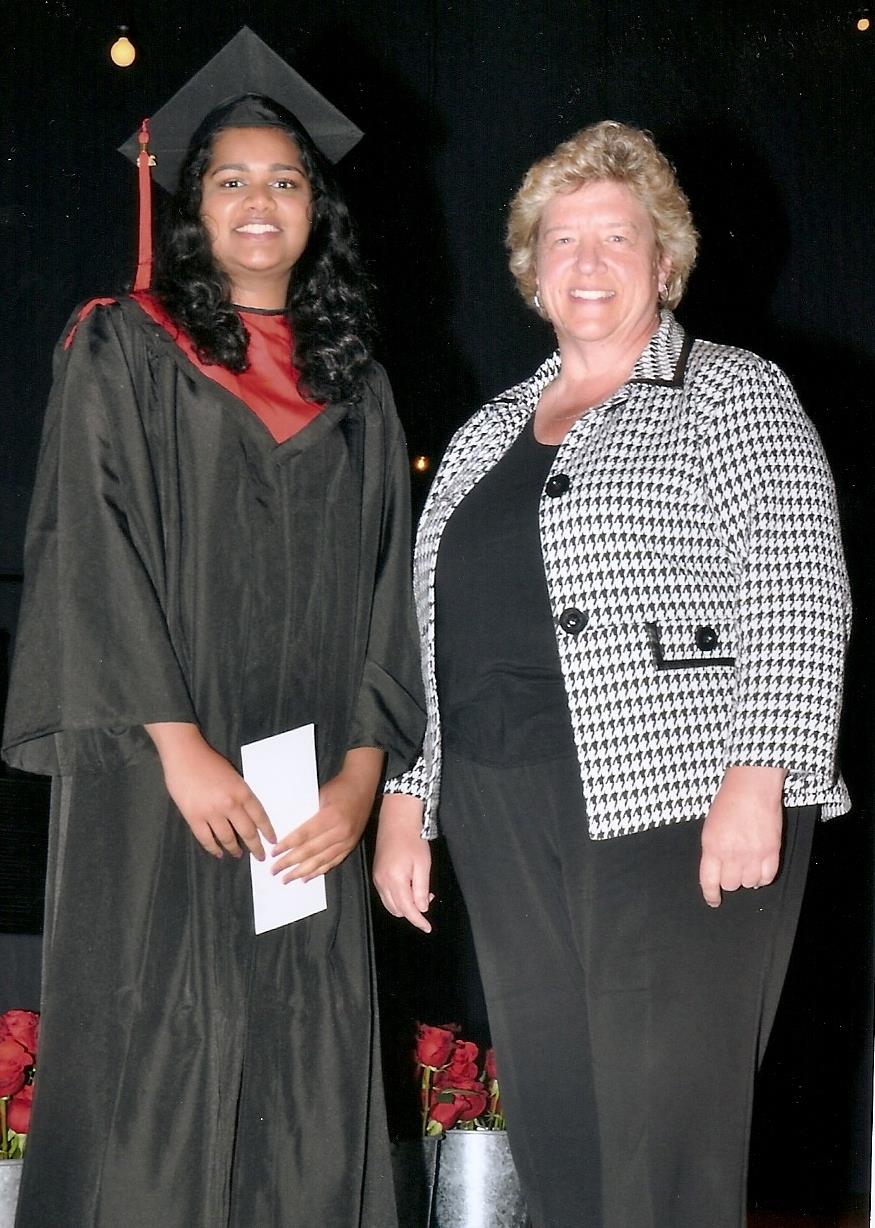
Rotary Club of Abbotsford - Awards Chair Pat Tonn & Neha Ravikumar of Abbotsford Sr. Sec School
 
 
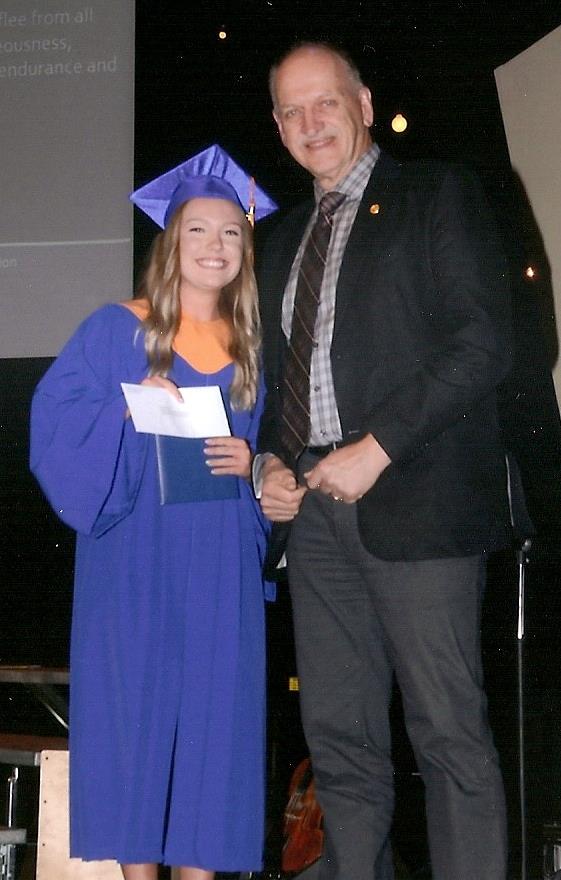
Club member Dave Loewen & Katelyn Ward of MEI Secondary School.
The Rotary Club of Abbotsford had a full house on Tuesday, as cheques were presented to the 4 community charities being awarded funding to help support local initiatives that will benefit children, youth, and at-risk sectors of our community. Each year the Rotary Club of Abbotsford accepts service project funding nominations/applications from local organizations. ”Determining the recipients, is always a difficult decision as Abbotsford is fortunate to have many worthy not-for-profit groups serving our community. After reviewing the applications and considering our key criteria the following organizations were selected” said Amy Badesha, Chair of Community Service Grants for the club.   
 
B.C. Agriculture in the Classroom Foundation - This organization works with educators to bring local agriculture to B.C. students. The funds that were awarded will be put towards the development of the ‘Spuds in Tubs program.’

Abbotsford Restorative Justice (ARJAA) works with youth in conflict with the law as they are held accountable for how they have harmed victims and the community. The funds being awarded will be used to enhance their Restorative Mentoring Program for at-risk youth by providing opportunities for them to participate in summer day camps with their Mentors to further engage and support the youth throughout the summer months.
 
L.I.F.E. Recovery- This organization’s name stands for ‘Living in Freedom Everyday’. They support at-risk women and provide residential housing for them. The funds will be put towards purchasing a much needed generator.
 
JOSHUA House- An organization that supports men with addictions and provides residential housing. The funds awarded will be used towards remodelling a kitchen.
 
“This past September, the Rotary Club of Abbotsford’s President’s Night – ‘Viva Las Rotary’ was a huge success and raised the funds that are now supporting these local Rotary service projects here in Abbotsford. We are so grateful to our sponsors, community partners, guests, and Rotarians who supported this event to raise much needed funds for these terrific community service projects and organizations that will go on to make a difference in the lives of many in our community, said Rotary Club of Abbotsford President, Stacey Irwin.”
 
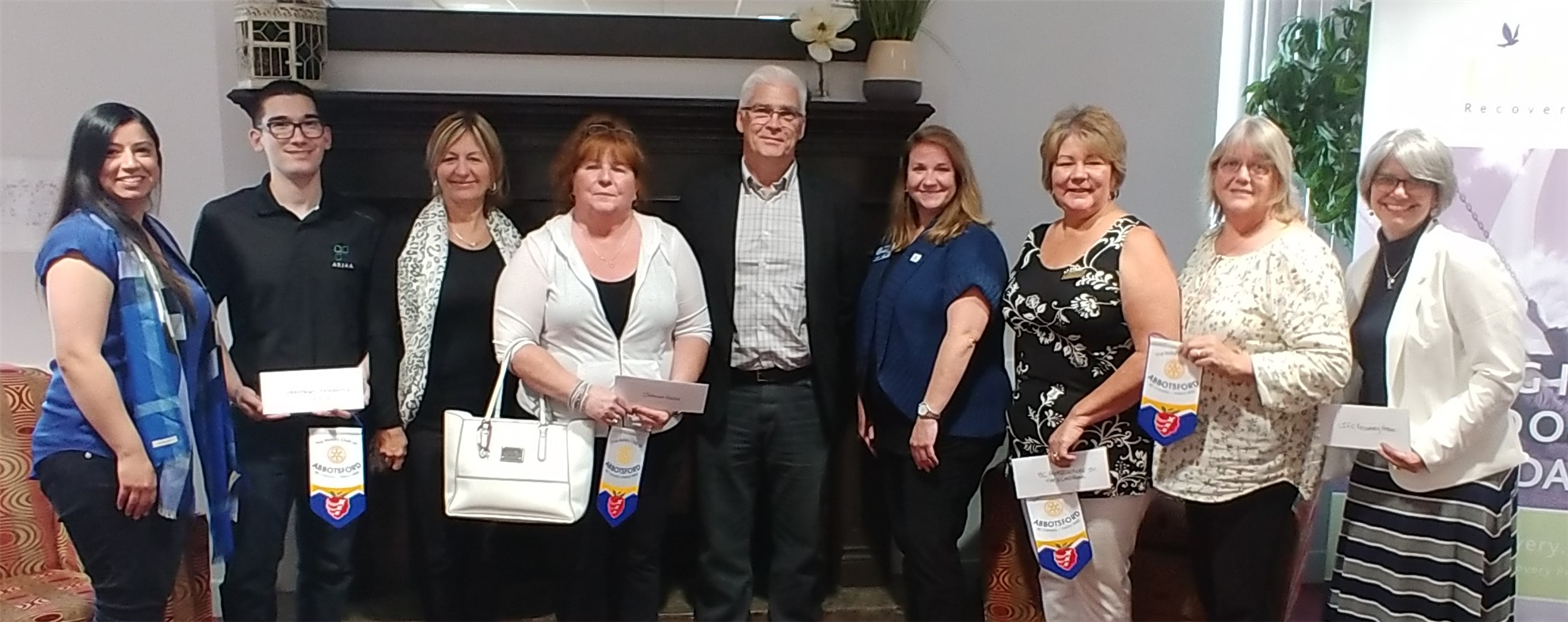
Left to right: Amy Badesha, Rotary Chair of Community Service Grants; Justin Hohne, Mentoring Program Coordinator and Joanne Field, Executive Director from Abbotsford Restorative Justice; Angie Korkowski, Executive Director and Eric Hoogenraad, Board Chair from Joshua House; Stacey Irwin, Rotary Club of Abbotsford President; Glenda Johnston, BC Agriculture in the Classroom Program Coordinator; Marian Vanderwal, Board Chair and Jeanne Murko-Wust, Executive Director with L.I.F.E Recovery Association.

Visit :-

EXPOSITION CH'TI BRICK A LENS LES 5 ET 6 AVRIL


Exposition Ch'ti Brick à LENS les 5 et 6 Avril


Une exposition Lego pour toute la famille avec le plus grand club Lego au nord de Paris
mardi 11 mars 2025

Le Rotary Club Lens-Liévin et l'association Ch'ti LUG organisent une grande exposition Lego à LENS le week-end des 5 et 6 avril 2025 !

Plus de 2300 m² consacrés à la petite brique légendaire salle Berthinchamps, rue Dénis Cordonnier.

Venez découvrir en famille des univers et réalisations spectaculaires pour petits et grands !

Tombola et animations au programme.

Entrée : 3€
De 6 à 12 ans : 1 €
Moins de 6 ans : gratuit

Samedi : 10h à 18h
Dimanche : 10h à 17h


On vous attend !


Visit :-

https://rotaryd1520.org/fr/content/news/show/22833


Le Mot du Gouverneur


Le Mot du Gouverneur

mardi 2 juillet 2024


Jean-Paul Hautier, Gouverneur 2024-2025

Chères amies et chers amis,


C’est avec une immense joie et un profond sentiment de responsabilité que je prends mes fonctions de Gouverneur pour l'année rotarienne 2024/2025. Aujourd'hui, nous commençons une nouvelle aventure sous le signe de la Magie du Rotary, une opportunité exceptionnelle pour chacun d’entre nous, de faire briller notre engagement et notre passion pour le service aux autres.


Notre Présidente internationale, Stéphanie Urchick, nous inspire avec des orientations claires et ambitieuses. Elle nous rappelle l'importance de la paix positive sur laquelle nous reviendrons, de la protection de l'environnement, de l'éradication de la polio, et de l'application rigoureuse de notre plan d'action avec ses quatre priorités : accroître notre impact, élargir notre portée, renforcer l'implication des participants et améliorer notre capacité d'adaptation.


La paix positive est au cœur de nos actions. En tant que Rotariens, nous avons le pouvoir de construire des ponts et de favoriser des conditions propices à une coexistence harmonieuse. Chaque projet que nous entreprenons, chaque initiative que nous soutenons, contribue à instaurer un climat de paix durable.

L’environnement est un trésor que nous devons préserver pour les générations futures. Que ce soit par des actions locales de reforestation, de nettoyage de nos cours d’eau, d’initiatives d’éducation, de promotion de l’énergie renouvelable, chaque geste compte. Ensemble, nous pouvons faire une différence significative.

L’éradication de la polio reste un objectif majeur. Grâce à notre persévérance et à notre détermination, nous sommes plus proches que jamais d’un monde sans polio. Continuons à mobiliser nos ressources et à sensibiliser autour de nous afin d’atteindre ce but historique.


Nous avons un défi de taille devant nous : l'essor de nos effectifs. Pour que notre mouvement puisse se perpétuer et prospérer, nous devons attirer de nouveaux membres, tout en renforçant les liens avec ceux qui sont déjà parmi nous. La force du Rotary réside dans la diversité au sens large, notamment de vision des nouvelles générations dont le potentiel est une source d’enrichissement. Chacun d'entre nous a un rôle crucial à jouer, afin que cette année soit une année de succès et de satisfaction pour toutes et tous.


Ensemble, nous avons le pouvoir de réaliser des projets qui transforment des vies et des communautés. En unissant nos efforts, en partageant et en acceptant nos idées, en mettant en pratique nos valeurs, nous pouvons créer un monde meilleur et plus juste.

Je vous invite à embrasser cette nouvelle année avec enthousiasme et détermination. Faisons preuve d’audace, soyons créatifs et n’hésitons pas à faire preuve de magie dans nos actions. Ensemble, faisons briller l'étoile du Rotary encore plus fort.

Je suis convaincu que, main dans la main, nous pouvons accomplir des merveilles. Merci pour votre engagement, votre passion et votre dévouement. Et surtout entretenez la camaraderie, valeur la plus fondamentale de notre mouvement. À nous tous de jouer !

Et n’oubliez pas ce qui nous rassemble :

« Nos cinq valeurs et notre guide éthique de discernement, le critère des quatre questions 


Vive le Rotary, vive la Magie du Rotary !

Jean-Paul Hautier, Gouverneur 2024-2025

Visit :-:-

https://rotaryd1520.org/fr/content/news/show/21241